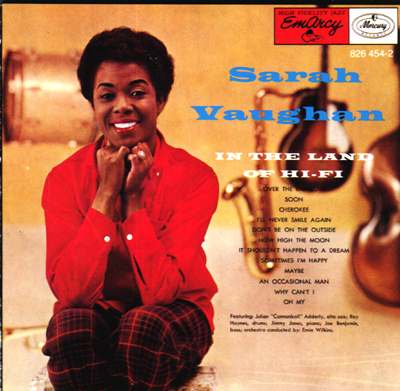
Since Dec,01,1998
©1998 By barybary
|


Japan Mini Lp reissue
SARAH VAUGHAN
with the Ernie Wilkins
Orchestra.
Ernie Royal, Bernie Glow, trumpets;
J.J. Johnson, Kai Winding, trombones;
Julian "Cannonball" Adderley, Sam
Marowitz, alto saxes;
Jerome Richardson, flute, tenor sax;
Jimmy Jones, piano;
Turk Van Lake, guitar;
Joe Benjamin, bass;
Roy Haynes, drums.
Arranged and
Conducted by Ernie Wilkins Recorded October25, 1955.
1 OVER THE RAINBOW (Yip Harburg/Harold Arlen)
3:28
2 SOON (George
and
Ira Gershwin) 2:34
3 CHEROKEE (Ray
Noble)
2:30
4 I'LL NEVER SMILE AGAIN (Ruth Lawe) 2:34
5 DON'T BE ON THE OUTSIDE (Sydney Wyche/Mayme Watts/George Kelly) 2:59
6 HOW HIGH THE MOON (Nancy
Hamilton/Morgan Lewis) 2:35
7 IT SHOULDN'T HAPPEN TO A DREAM (Dan George/Duke Ellington/Johnny Hodges)3:18
8 SOMETIMES I'M HAPPY (lrving Caesar/Clifford Grey/Vincent Youmans) 2:56
9 MAYBE (George
and
Ira Gershwin) 2:31
10 AN OCCASIONAL MAN (Hugh
Martin/Ralph Blane)
2:30
11 WHY CAN'T I (Richard
Rodgers/Lorenz
Hart) 2:54
12 OH MY (Joe
Greene) 2:22
Track List of the Cd reissue Emarcy– EJD-3087 with
bonus Tracks
| 1 |
|
Over
The Rainbow |
| 2 |
|
Soon |
| 3 |
|
Cherokee |
| 4 |
|
I'll
Never Smile Again |
| 5 |
|
Don't
Be On The Outside |
| 6 |
|
How
HighThe Moon |
| 7 |
|
It
Shouldn't Happen To A Dream |
| 8 |
|
Sometimes
I'm Happy |
| 9 |
|
Maybe |
| 10 |
|
An
Occasional Man |
| 11 |
|
Why
Can't I |
| 12 |
|
Oh
My |
|
|
Bonus Tracks |
|
| 13 |
|
Over
The Rainbow |
| 14 |
|
I'll
Never Smile Again |
| 15 |
|
I'll
Never Smile Again |
| 16 |
|
Don't
Be On The Outside |
| 17 |
|
Sometimes
I'm Happy |
| 18 |
|
Sometimes
I'm Happy |
| 19 |
|
Sometimes
I'm Happy |
| 20 |
|
Oh
My |
| 21 |
|
Oh
My |
|
|
|
|
|
|
|
|
|
The glorious voice of
Sarah Vaughan has been
heard in every setting from a small rhythm combo to
a full string
ensemble, but the accompaniment on these sides is
something new.
Ernie Wilkins was the arranger and conductor for the
big,
swinging band on the three sessions recorded in
November, 1955.
There were four trumpets (Ernie Royal played some of
the lead),
four trombones (including a noted two-trombone
team), and a five
man saxophone section in which the featured soloist
is Julian
"Cannonball" Adderley, the Florida flash, who flew
north with alto under arm especially to take part on
these dates.
The rhythm section comprises Sarah's usual
sidekicks, pianist
Jimmy Jones, drummer Roy Haynes and bassist Joe
Benjamin, with a
guitarist added in the person of Turk Van Lake.
That the music provided for this stellar line up is
worthy of
Sarah's and the musicians' talents should come as no
surprise to
anyone familiar with Ernie Wilkins' contribution to
the modern
music scene. Born in 1922 in St. Louis, he studied
at Wilberforce
University, then spent three years in the Navy, most
of this time
being devoted to the great all-star band stationed
at Great
Lakes, with Clark Terry, Willie Smith, Gerald Wilson
and a number
of others who later achieved fame with name bands.
After leaving the Navy, Ernie worked with George
Hudson, Earl
Hines and Count Basie. He left Basie early in 1955
to stay in New
York and concentrate on free-lance arranging, mainly
for Basie,
the Dorsey Brothers and for various recording dates.
His work for this Sarah Vaughan session illustrates
how firmly
the roots of his work are planted in jazz soil, for
the band
swings consistently, not only in the overall
ensemble and in the
rhythm section feeling, but in the writing for the
variously
voiced horns behind Sarah.
The incredible Sassy is at her most astonishing at
this session.
Bending the melodies to her unique individual
conception,
swooping up for unexpected high notes, soaring in
for fabulous
top-register endings, she demonstrates her uncanny
flair for
vocal calisthenics to an unprecedented degree.
Some of the material will be familiar, though a
couple of the
tunes are lesser-known old songs, while two or three
are 1955
compositions that happen to fit her style well
enough to have
earned permanent preservation between LP covers.
Over the Rainbow is about as un-Judy
Garland-like
as you might expect, notice the ingenious
repetitious use of the
"blue" in "bluebirds" during the final eight
bars, and the beautiful tonal quality achieved
through the whole
performance.
Soon, one of two well known standard
songs by this
title, is the George and Ira Gershwin number,
written in 1929,
taken at a
medium-swing pace. Ray Noble's Cherokee, almost
always
done as an instrumental nowadays, gets its first
female
vocal treatmen (The lyric was changed by special
permission from
the publisher.) The only interruption occurs when
Sarah lets
Cannonball take over for one exciting chorus.
Don't Be On The Outside is a new song
with a 12-bar
main phrase in which Sarah wails with a wonderful
beat. I'll
Never Smile Again, made famous some 16
years ago by Tommy
Dorsey's version, is one of the prettiest items in
this
collection.
How High The Moon is Sarah's first
recorded version
of the tune that practically became the national
anthem of the
modern jazz movement back when Sarah, Dizzy and
Charlie Parker
were pioneering in the mid- 940s. Cannonball takes a
great
chorus; then, wearing earphones to enable him to
hear Sarah's
voice (isolated in a booth for the session) he can
be heard in a
unique and delightful series of four-bar "chases"
with
Sarah. Once again the amazing high-note technique of
Miss V.
leaves you just about breathless. This is certainly
one of the
most unusual and memorable versions of How
High ever
recorded.
It Shouldn't Happen To A Dream is a
fine Duke
Ellington tune of a few years ago, written in
collaboration with
Johnny Hodges and lyricist Don George. Ernie's
backgrounds with
muted brass, saxes and piano ingeniously interwoven
are
especially effective.
Sometimes I'm Happy gets a bright
tempoed
treatment; Maybe, a song by the
Gershwins dating
from 1926, is melodiously revived. An
Occasional Man, with
its witty lyric and catchy melody, is a 1955 product
of the
well-established firm of Hugh Martin and Ralph
Blanc, heard in
the movie The Girl Rush.
Why Can 't I is a
Rodgers and
Hart song of 1929, sung superbly and leading to
another
incredible last note on a high F. Finally there's Oh
My!.
a clever novelty by west coast songsmith Joe Greene,
with a Latin
rhythm touch and some Jerome Richardson Ilute in the
background.
As you've probably
gathered by now, this is
quite a set - even by Sarah's own altissimo
standards.
|
|