|
Cannonball
Adderley
Alto Sax, Nat Adderley Cornet, Charles
Lloyd Tenor Sax,
Joe Zawinul Piano, Sam
Jones
Bass, Roy McCurdy Drums
"Work Song,
The Song My
Lady Sing,
WABC-FM Radio
Broadcast , HALF NOTE Café , February 29 , 1965
Cannonball Adderley
Alto Sax, Nat Adderley Cornet, Charles
Lloyd Tenor Sax,
Joe Zawinul Piano, Sam
Jones
Bass, Roy McCurdy Drums
Unit Seven"
WABC-FM Radio
Broadcast , HALF NOTE Café , april 23 , 1965
Cannonball Adderley Alto
Sax, Joe Zawinul Piano,
Herbie Lewis Bass, Roy
McCurdy Drums
"Stars Fell on
Alabama"
"The Little Boy
with
The Sad Eyes,
Midnight Mood,
Fiddle on the Roof"
WABC-FM Radio
Broadcast , HALF NOTE Café , February 27 , 1966
*
- In the CD inlay as the recording date is
mentioned: last week of December 1967 / first week
of January 1968. However Charles Lloyd left
Cannonball Adderley in 1965 and never performed with
him again.
There is a tradition
of live azz
on the radio in New York that goes bock mare than
fifty years.
From the big band remotes of the 30s through
Symphony Sid's
broadcasts from Birdland in the 40s and 50s up to
today's
American Jazz Radio Festival, heard over WBGO/FM,
there is always
some live jazz somewhere on the New York radio dial.
In the late sixties, jazz disc jockey Alan Grant did
a series of
live broadcasts from the legendary Half Note. The
club was owned
and operated by the Canterino family and was the
kind of place
musicians loved to play. Whoever was appearing at
the club that
week would do Grant's live remote an Monday night.
Fortunately,
he taped many of his broadcasts and saved some
incredible music,
including these great performances by Cannonball
Adderley, from
permanent exile into the ether.
The bulk of the music on this record comes from two
separate
broadcasts. One of the shows occurred in the last
week of 1967
and the other is from the first week in 1968. There
are
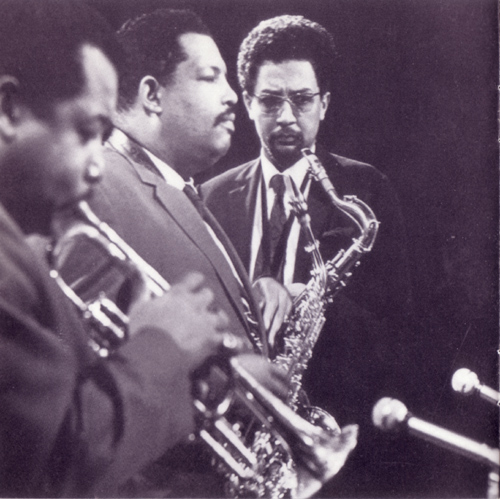
performances by two of Cannon's best groups, the
Quintet (Sam
Jones, Louis Hayes, Cannonball Adderley, Nat
Adderley, Joe
Zawinul) and the Sextet (Roy McCurdy, Charles Lloyd,
Joe Zawinul,
Sam Jones, Cannonball Adderley, Nat Adderley). The
montage at the
end of the record is from Todd Barkan's club,
Keystone Korner, in
San Francisco. Both of these clubs are gone now, but
they were in
their day, home to some of the best jazz ever.
Had he just been the consummate saxophonist that he
was, it would
have been a major accomplishment. But Cannon was
more. He was an
entertainer, raconteur, political animal, composer,
talent scout,
teacher and pupil. He was exceptionally bright and
witty and had
a deceptively even facade, on and off stage, that
belied his
complexity.
As fortunate as Night Records has been in finding
this music,
we're equally excited about having access to a
series of
interviews with Cannonball done by Chicago writer,
Judy Smith.
Smith is in the process of writing a biography of
Cannon and was
kind enough to allow us to use excerpts from those
interviews as
part of these notes. Hopefully, through the words of
his friends
and family, you'll get a broader picture of an
uncommomly gifted
artist. Here he is remembered by his fellow
musicians, and
especially by his immediate family - his brother
Nat, Nat's wife
Anne, and Cannon's wife Olga.
Nat Adderley
One of the things, especially with Cannon, one of
the things that
was against us was that we came from what can be
described as a
middle class family. We were not poor, and we did
not crawl up
out of the ghetto, or puIl ourselves up by the
bootstraps. Our
parents were both college graduates, both were
teachers, which is
an honorable profession although it's not a very
rich one. And we
came to New York, both with college degrees, at a
time when most
people couldn't even read music. That didn't sit
well with some
critics. For a long time we had trouble with
acceptance because
we were not drug-crazed people who got screwed up
and did crazy
things. We were very normal. We didn't came to New
York to join
that scene, so it set us apart. We worked
instinctively together.
Having grown up playing together, in many ways we
were one as
performers. We could almost anticipate the phrasing
and harmonies
of the other. It was a sad day for us when our band
broke up in
1956. We always intended to get it back together.
Although Cannon
was honored to play with Miles Davis and John
Coltrane in that
landmark band, he never lost sight of his goal to
reform the
quintet and record his own material.
Although our mother's religious roots were more
deeply southers,
we were raised in the religion of our father, whose
family
brought their Anglican (Episcopalian) religion with
them from the
British Bahamas. As a result, we did not grow up
with the
intensely soulful, gospel-oriented music one might
think from
listening to our recordings. The music of the
Anglican church
tends to be highly stylized, formal. We did walk
past juke joints
on our way to school, and we could hear T.Bone
Walker, B B King,
and Eddie "Cleanhead" Vinson on the box. Jackie
Byard
was stationed in Florida. He and Trummy Young took
us to a juke
joint where we heard the music of Bird and Dizzy. We
were blown
away. This was the forties, and be-bop was so hot
and innovative,
it was blowing all the musicians away. Also we lived
across the
street from the Tabernacle Baptist Church, and were
fascinated by
the gospel rocking that came from that church,
especially
compared to our awn. And at home we listened to
music in a more
legitimate vein, Paul Robeson and Marian Anderson.
Anne Adderley
Cannonball was like my mentor, in a sense, and yet
he was like a
child of mine in another sense. Cannon would come in
and give me
his money to manage better than Nat did. I'd give
him an
allowance and he'd come in and borrow money all the
time. He was
always needing five dollars. I don't know how we
would have made
it without Cannonball. He loved Nat so much and he
always took
care of him like his little brother, and I was his
little sister.
And yet like I say, Cannonball was a big pussycat
himself, a big
baby.
Olga Adderley
He was disciplined as an artist. I think that Julian
had a
certain overview. I don't think he was disciplined
about money,
or as careful in those areas, because I don't think
they meant as
much to him. He wasn't disciplined about his
appetite. But I also
think that Julian may have thought that there was no
point in
being disciplined because of his health problems. I
think that
Julian was determined fo have as much of life as
possible. He had
on-going dental problems, and everytime Julian had
to go through
a change in his embouchure and adjust his playing,
it really
messed up his mind. Because his identity, his
concept of self,
was tied up in what he did. He was vulnerable too
and I didn't
want anyone messing with him. Under all of the
words, and under
all of the assurances, under all of the competence,
in some areas
he had a vulnerability that he didn't want anyone to
stomp on.
He wasn't threatened at all having another sax
player on the
stand. I can remember Julian coming home during that
period (63
to 68) and saying how wonderful things were with the
band. Julian
thought about music, but he didn't practice at home.
He'd write
music at home and we listened to music at home and
one of the
things that I used to see was that he'd get up in
the middle of
the night. I could see that he roamed or that he had
gone to his
desk and worked on something. But he told me that
they did their
practice in the clubs and on the stand. That he thought
it
. Early on they did a concert at Carnegie Hall and
they asked him
to play solo on an orchestrated number, "Somewhere"
from West Side Story. And Julian didn't practice and
he came home
and knew that he had to do that, and he thought
and thought
it. It was one of the most wonderful things I ever
heard him do.
And eventually, he recorded it, but the first time,
Julian didn't
rehearse. He came home and thought it, thought about
the music.
I didn't listen to the radio far two years after his
death. After
he died it was so painful to turn on the radio and
hear him by
accident. I just totally did not listen to the jazz
or pop
stations for two years. And I think that when he'd
been dead a
couple of years, "Big Man" came out and that was all
right. Then I could hear the music again without
freaking out.
Yusef Lateef
There was an affection between the Adderley brothers
that was
beautiful to see. it would warm your heart. They
respected and
cared for each other so much. It was joyous to watch
them, to
listen to them talk to each other, to see them look
at each
other. And Cannonball extened that warmth to me and
those others
in the band. He was a wonderful human being as well
an artist.
Cannonball told me he was teaching school in Fort
Lauderdale,
Florida at the time he heard about Charlie Parker's
demise. At
that moment he said to himself, "Well, now I can go
to New
York." It was within months after Bird died that he
went to
New York.
Roy McCurdy
We were working a lot, we were travelling
by car then,
we weren't flying. It wos really close knit.
Everybody loved each
other. Like a family, friends, we used to fight like
a family, we
did everything. We travelled in these two station
wagons across
the country, hack and forth. I miss the band, I do.
I miss
Cannon, I miss the fun that we all had all the time.
I miss
everything that was going on. Spontaneity! When we
went on the
stand with Cannon we never knew what we were going
to play. We'd
just go up look at the audience, he could tell right
away what
they would love and what they wouldn't like and
things like that,
and we hit from there. And usually, 90% of the time
it was right
on the money.
Joe Zawinul
He always had a cigarette between his fingers but he
played so
fast and powerful and so great.. .and I never heard
him stumble.
And then he had this gift to talk to the people in a
very
nonchalant and yet informative way about many
things. We used to
kill people; the band was really on FIRE !
Nancy Wilson
Julian described his music better than anyone I have
ever known.
He mode you impatient to hear the music because he
described it
so beautifully. His concept of the music coupled
with his command
of the English language made people understand what
was going on
musically.
Phil Woods (describing the first
time Cannonball
played in New York)
We were all Bird's children, I guess.
Jackie
McLean come to me one night. He says, "Come with
me."
He was working the Cafe Bohemia. He was the opening
act for Oscar
Pettiford's big band. And he said, "Come over and
check this
out ". I walked in and it was Cannonball's first
night in
town. It's the night he sat in. And I remember
Jackie and I were
in the back listening to this son of a bitch play
the saxophone
like no human being had played it before. He was
superb. And I
remember, I looked at Jackie and Jackie looked at
me, and at the
same time we both said, "Oh shit !"
These performances
by Cannon
were recorded in the last week of 1967 and the
first week of 1968
by Alan Grant at the old Half Note in New York
City His vision in
recording and preserving this music and his
kindness in bringing
it to our attention is much appreciated. We'd also
like to thank
the Canterino family, who owned and operated the
Half Note, for
their cooperation in the release of this material.
Finally, a
special thanks to Michael Cuscuna and Bruce
Lundvall of blue Note
Records and Bob Young of Capitol Records, for
their help in
securing the clearances necessary for the release
of this
material. Cannon was under contract to Capitol at
the time of
these recordings.
|