|
Biography
Julian
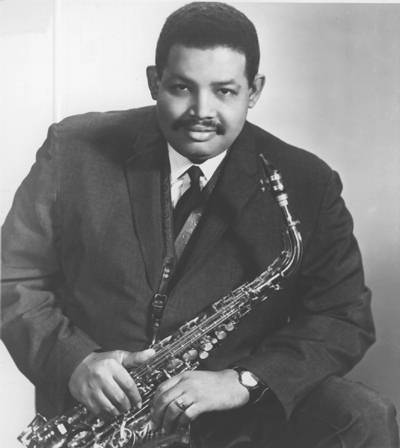
Edwin "Cannonball" Adderley
Do you know other Pseudo
??CLick here for complete list
TAMPA
,Florida,09/15/1928//GARY,Indiana 08/08/1975
after
his music studies in Tallahassee(1944/48) he became a high
school band director at the Dillard High School/Fort
Lauderdale (1948/50)in his native Florida , following in the
footsteps of his educator-father(a trumpet player),before
moving to New York in 1955. He initially planned to pursue
graduate studies in Manhattan; but after sitting in with
Oscar Pettiford's band at the Cafe Bohemia, the alto
saxophonist became an instant sensation, hailed by many as
the musician most likely to e the mantle of the late Charlie
Parker. Despite misguided promotional efforts to christen him
as "the new Bird," Adderley clearly had his own
approach to the horn, which drew on the inspiration of Benny
Carter as well as Parker. He took advantage of his early
notoriety, however, by forming his first quintet, which
featured his younger brother Nat Adderley on cornet. While
the group struggled economically, Cannonball did draw the
attention of Miles Davis,who featured the alto saxophonist in
the immortal Miles Davis sextet (alongside John Coltrane and
either Red Garland, Bill Evans,or Wynton Kelly) for two years
beginning in late 1957.
In September 1959, Cannonball left Davis and reunited with
Nat in a new Cannonball Adderley quintet. Recorded live one
month later at San Francisco's Jazz Workshop, the band became
an immediate success with their version of Bobby Timmons's
sanctified waltz "This Here" and a leading
practitioner of what came to be called soul jazz. Numerous
other hits followed over the next 16 years as the band
occasionally swelled to sextet size (with the inclusion of
Yusef Lateef or Charles Lloyd) and featured such important
pianist/composers as Barry Harris, Victor Feldman, Joe
Zawinul,George Duke, and Hal Galper. Sam Jones and Louis
Hayes formed the original rhythm section, to be succeeded
later by Victor Gaskin,Walter Booker, and Roy McCurdy. At the
heart of the group's success throughout its existence were
Cannonball, one of the most impassioned alto (and, later,
soprano) saxophonists in jazz history, and Nat,whose
infectious compositions (including "Work Song" and
"Jivesamba") formed a critical part of the band's
book.
While a knack for interpreting funky crossover material such
as Zawinul's "Mercy, Mercy, Mercy" won the Adderley
quintet one of the jazz world's largest audiences,
Cannonball's personality also played a pivotal role in
sustaining the band's prominence among fans worldwide. He was
the most articulate and engaging of musicians,and he
invariably educated his listeners with wry commentary that
illuminated the music. He was also a voracious listener and
talent scout who introduced several prominent musicians
through both employing them in his ensemble and serving as a
studio record producer. Cannonball was the one who called Wes
Montgomery to the attention of Riverside Records, produced
the debut recording of Chuck Mangione, and collaborated so
brilliantly with a young Nancy Wilson. The open, affirmative
personality he displayed on stage was reflected in his music,
which over time was touched by the subtle eloquence of his
former boss Miles Davis and the exploratory intensity of his
Davis colleague John Coltrane.
Adderley also served as a prominent spokesperson for jazz
through extensive television work and residencies at several
universities.Shortly before his death following a stroke, he
had recorded his original music for "Big Man," a
"folk musical" based upon the life of John Henry.
source:
Fantasy.com
|